Finding Form Beyond Tradition
Modern sculptors aren’t abandoning the old ways they’re bending them. Classical technique still holds weight. Anatomy, proportion, and material knowledge are the backbone of many works. But today, that foundational skill isn’t the end point it’s the launchpad. Sculptors are pushing beyond tradition to speak in louder, stranger, more personal voices.
Materials have exploded beyond marble and bronze. Found objects, recycled plastics, street detritus, and even digital matter 3D printed components, holograms, projection mapping are fair game. The medium now matches the message. If the story is about loss, fragility, or consumer decay, a perfectly polished bust might miss the mark. Instead: scratched plexiglass, stitched leather, rusted metal honest materials that carry emotion.
And that’s the shift: we care less about photographic realism and more about emotional weight. A crooked wire figure can say more than a lifelike torso if it hits the right nerve. Sculptors aren’t just replicating bodies they’re revealing states of being. This is work that wields technique in service of truth, and lets raw feeling shape the form.
The Studio as a State of Mind
Sculpting may be physical, but for many contemporary artists, the mental and emotional environment of the studio is just as integral as the tools in hand. Modern sculptors cultivate routines that ground their practice, sustain their vision, and create space for introspective work.
Rituals That Shape the Creative Day
While each artist’s process is unique, effective sculptors often share certain foundational habits that support long term creativity:
Consistent hours: Starting and finishing at regular times to reduce decision fatigue
Workspace curation: Organizing tools, lighting, and materials to signal focus and readiness
Pre creation warmups: Sketching, journaling, or handling materials before diving into major pieces
These rituals help transition from everyday distractions into the deeply focused state necessary for emotionally driven work.
Discipline Under the Surface
Behind every grand, emotionally resonant sculpture lies a quiet routine of repetition and persistence. Large scale works especially those meant to evoke deep sentiment require not just physical labor but psychological endurance.
Artists must return daily to the same challenging work for weeks or months
Emotional themes are revisited over time, evolving with each pass
Patience is critical; shortcuts dilute impact
Discipline, in this context, isn’t cold structure it’s the vessel that carries emotional integrity forward.
Solitude as Creative Fuel
In an increasingly connected world, meaningful reflection can be rare. And yet, solitude remains a central ingredient in many sculptors’ practices. Time alone fosters deeper emotional processing, allowing artists to access the inner layers they aim to bring to the surface through form.
Solitude allows ideas to incubate beyond the noise of outside input
It creates room for uncomfortable truths to surface often the root of powerful art
This space between thoughts is where meaning tends to emerge, unforced
In the studio, silence becomes an active force. Reflective practice isn’t an escape from emotion it’s how sculptors better understand and eventually shape it.
Tools of the New Trade
Sculpture has never stood still. Today’s tools are expanding what’s possible without erasing centuries of technique. 3D modeling software, CNC routers, and AR assisted installations now sit alongside chisels and clay. These tools aren’t shortcuts they’re extensions of the sculptor’s intent. Digital modeling allows for precise planning. CNC machines transform complex designs into physical form with ruthless accuracy. Augmented reality helps sculptors place their work within imagined or real world environments before a single material is touched.
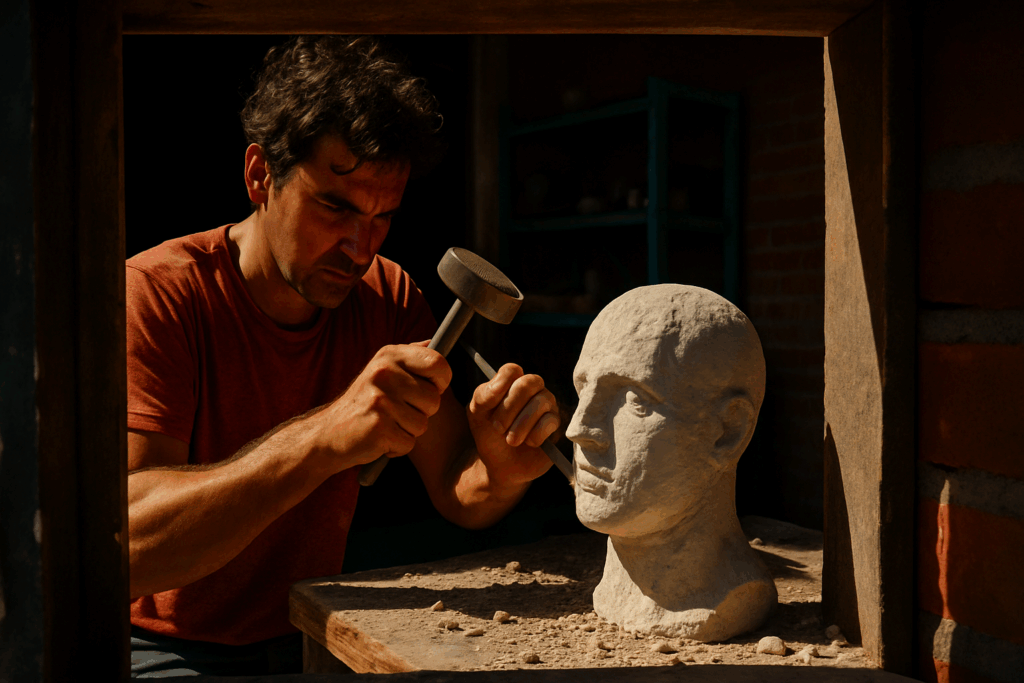
Yet, despite the digital wave, hand carving still holds its place. There’s something about direct contact with stone or wood that no screen or machine can replicate. That friction, that resistance it pushes the artist to slow down, to feel their way through an idea rather than engineer it.
And in this high speed world, texture is becoming a kind of language. A surface can whisper. Before a viewer reads artist statements or scans QR codes, their fingers and eyes register the story carved into the material. Tactility builds trust. It speaks in skin and gut. This isn’t nostalgia it’s human design.
The Role of Urban Environments

You don’t need white walls and silence to make sculpture matter. More and more, sculptors are dropping their work into the noise of public life train stations, sidewalks, rooftops. These aren’t just monuments to be admired from a distance. They’re objects made to be lived around, leaned on, tagged, questioned. Their meaning shifts with the context, the time of day, who’s passing by.
Outdoor installations carry emotional weight because they don’t exist in a vacuum. The rust on steel, paint weathered by rain, the layers of graffiti left by locals these tell their own story. Sculptors working in these spaces often lean into that decay, that unpredictability. It’s not pristine. It’s real.
There’s a clear kinship with street artists. The same impulse to leave a human mark, to provoke response without needing permission. For an eye opening look at this crossover, check out the urban artist exhibit. The tactics may differ welding vs. wheatpaste but the drive? Nearly identical: claim space, stir emotion, leave something behind that speaks.
Sculpture is no longer tucked away or sealed off. It’s embedded, reactive, and often stronger because of it.
Message vs. Medium
Modern sculptors aren’t just crafting objects they’re processing reality. The subjects they choose often tap into something heavier: a protest that never made the news, a parent’s silent grief, a memory kept alive through shape and shadow. These aren’t decorative pieces. They’re pressure valves.
The “why” behind a sculpture is pulling more weight than ever. In a world where images scroll past in seconds, it’s the message that makes a viewer stop and feel. The medium might be concrete, wire, or repurposed wood but without a reason driving it, the result often feels hollow. Artists today are anchoring their work in deeply personal or collective narratives. The goal isn’t perfection. It’s connection.
And that goes beyond the surface. Sculptors are manipulating form, void, and space not just for aesthetics, but for emotional metaphor. A hollowed out torso might say more about loss than words ever could. A mass of tangled wires can capture cognitive overload. Space becomes language the negative form between elements is as intentional as the sculpted matter itself. It’s not just what’s there; it’s what isn’t. That absence speaks volumes.
The Evolving Definition of Audience
Not that long ago, sculpture was something you visited. You went to a gallery or museum. You stood behind a rope, kept your hands to yourself, and moved along. That was the deal. Now? The deal’s changing.
Today’s sculptors are meeting people where they are on sidewalks, in subways, in makeshift lots turned art spaces. Accidental audiences matter just as much as ticketed ones. A commuter brushing past a steel figure during rush hour might engage less formally than a gallery goer, but the emotional spark can be just as real.
Interactivity is no longer a novelty it’s part of the point. Works are being designed to be touched, walked through, or even re arranged. This kind of vulnerability from the artist invites vulnerability in return. The viewer is no longer just a viewer. They become part of the experience emotionally, sometimes physically.
When it works, there’s a kind of shared authorship. The sculpture reflects the artist’s intent, yes, but also the observer’s interpretation, their memory, their body in that moment. It’s a quiet collaboration. And it makes the emotional impact less about admiration from a distance, more about connection in real time. Artists are letting go of full control to leave space for something more human and more alive.
Where Sculptural Emotion is Headed
The Rise of Narrative Driven Sculpture
Sculpture is no longer just about shape and space it’s becoming a medium for storytelling. Contemporary sculptors are increasingly integrating narrative threads into their work, inviting viewers to walk through a story, not just witness a form. These stories range from deeply personal experiences to broader social commentaries, all told through material, form, and spatial dynamics.
Works now feel theatrical each angle may reveal a new chapter
Personal histories, political unrest, and collective fears become sculptural motifs
Pieces evolve from static objects to immersive experiences
Cross Disciplinary Collaboration
Modern sculptors are reaching beyond their studios, collaborating with creatives in other fields to expand both emotional and sensory impact. These partnerships create layered forms of expression that go well beyond what sculpture could once do alone.
Sound artists introduce auditory dimensions that shift space and draw emotion
Choreographers help translate movement and embodiment into sculptural rhythm
Architects bring structural scale and environmental context to installations
Together, these collaborations turn singular ideas into multidimensional emotional landscapes.
Following the Emotional Pulse of the Present
In a world marked by instability, identity exploration, and heightened vulnerability, today’s sculptors are capturing the rawness of contemporary experience. The emotional currents of everyday life grief, resilience, intimacy, unrest are being channeled through new sculptural forms.
Emphasis on imperfection and fragility as visual language
Use of unconventional materials to reflect discomfort, transition, or memory
Layering emotional content through scale, absence, or distortion
These sculptures mirror the unease and beauty of the times we live in, offering not just aesthetic experience, but emotional companionship.
For further exploration of emotion and space in urban art, revisit this thoughtful urban artist exhibit.
 Ismael Stansburyear has opinions about art exhibitions and reviews. Informed ones, backed by real experience — but opinions nonetheless, and they doesn't try to disguise them as neutral observation. They thinks a lot of what gets written about Art Exhibitions and Reviews, Artist Spotlights, Techniques and Tutorials is either too cautious to be useful or too confident to be credible, and they's work tends to sit deliberately in the space between those two failure modes.
Reading Ismael's pieces, you get the sense of someone who has thought about this stuff seriously and arrived at actual conclusions — not just collected a range of perspectives and declined to pick one. That can be uncomfortable when they lands on something you disagree with. It's also why the writing is worth engaging with. Ismael isn't interested in telling people what they want to hear. They is interested in telling them what they actually thinks, with enough reasoning behind it that you can push back if you want to. That kind of intellectual honesty is rarer than it should be.
What Ismael is best at is the moment when a familiar topic reveals something unexpected — when the conventional wisdom turns out to be slightly off, or when a small shift in framing changes everything. They finds those moments consistently, which is why they's work tends to generate real discussion rather than just passive agreement.
Ismael Stansburyear has opinions about art exhibitions and reviews. Informed ones, backed by real experience — but opinions nonetheless, and they doesn't try to disguise them as neutral observation. They thinks a lot of what gets written about Art Exhibitions and Reviews, Artist Spotlights, Techniques and Tutorials is either too cautious to be useful or too confident to be credible, and they's work tends to sit deliberately in the space between those two failure modes.
Reading Ismael's pieces, you get the sense of someone who has thought about this stuff seriously and arrived at actual conclusions — not just collected a range of perspectives and declined to pick one. That can be uncomfortable when they lands on something you disagree with. It's also why the writing is worth engaging with. Ismael isn't interested in telling people what they want to hear. They is interested in telling them what they actually thinks, with enough reasoning behind it that you can push back if you want to. That kind of intellectual honesty is rarer than it should be.
What Ismael is best at is the moment when a familiar topic reveals something unexpected — when the conventional wisdom turns out to be slightly off, or when a small shift in framing changes everything. They finds those moments consistently, which is why they's work tends to generate real discussion rather than just passive agreement.